PDC or tricone for water wells? An honest comparison
PDC bits shear, tricones crush. That one difference decides which is faster, which survives boulders, and which is actually cheaper per metre.
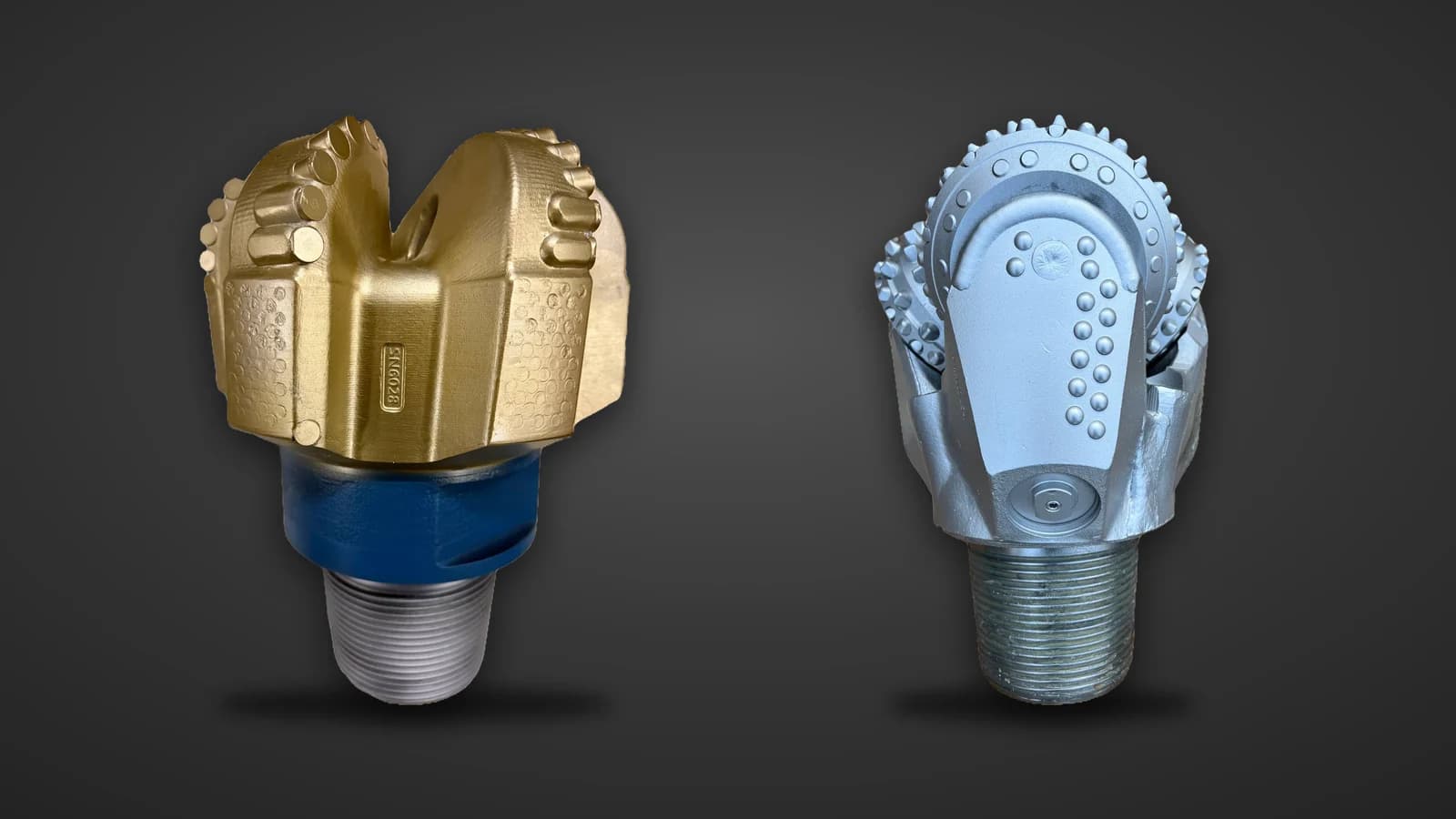
Two different ways of breaking rock
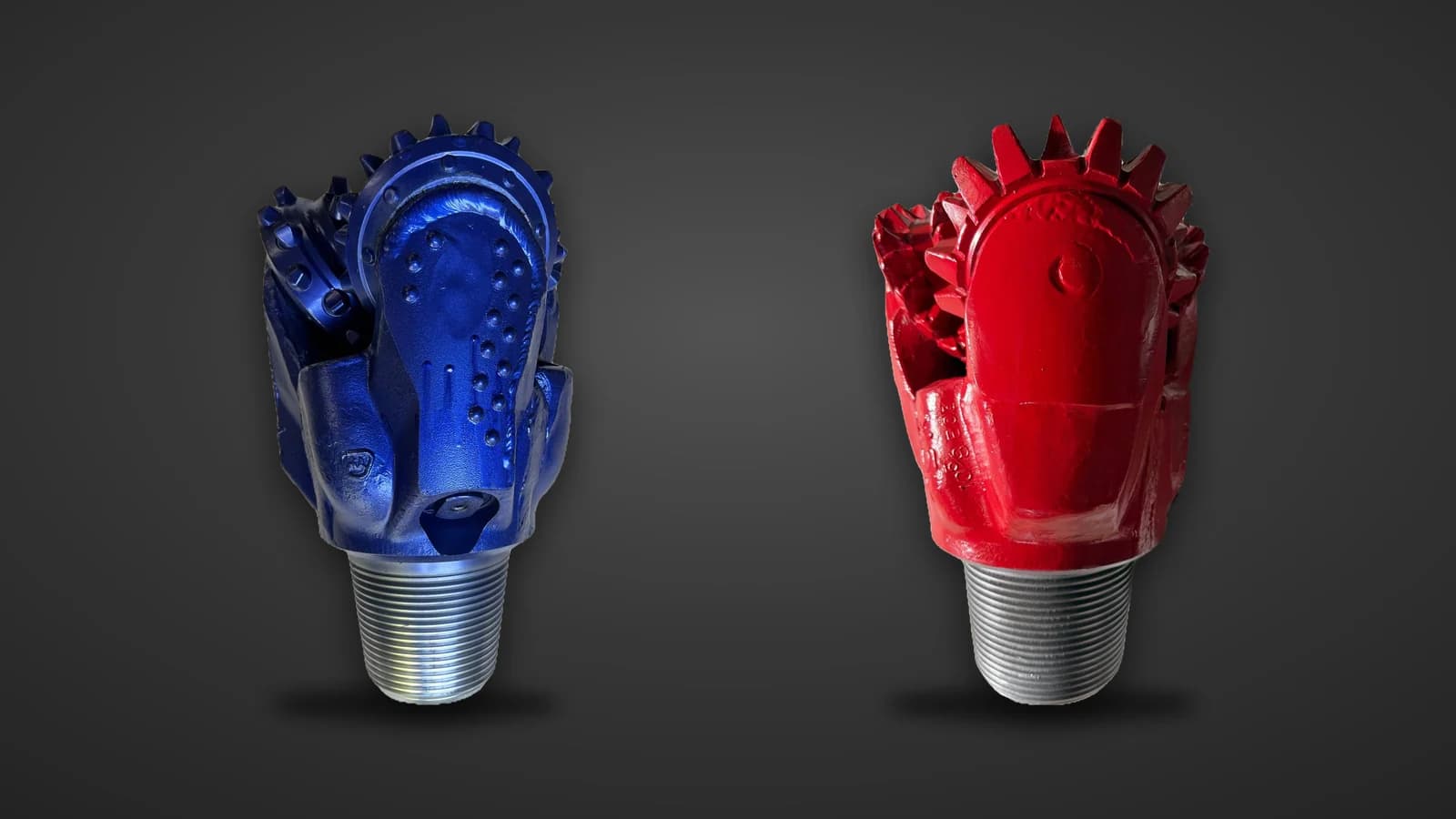
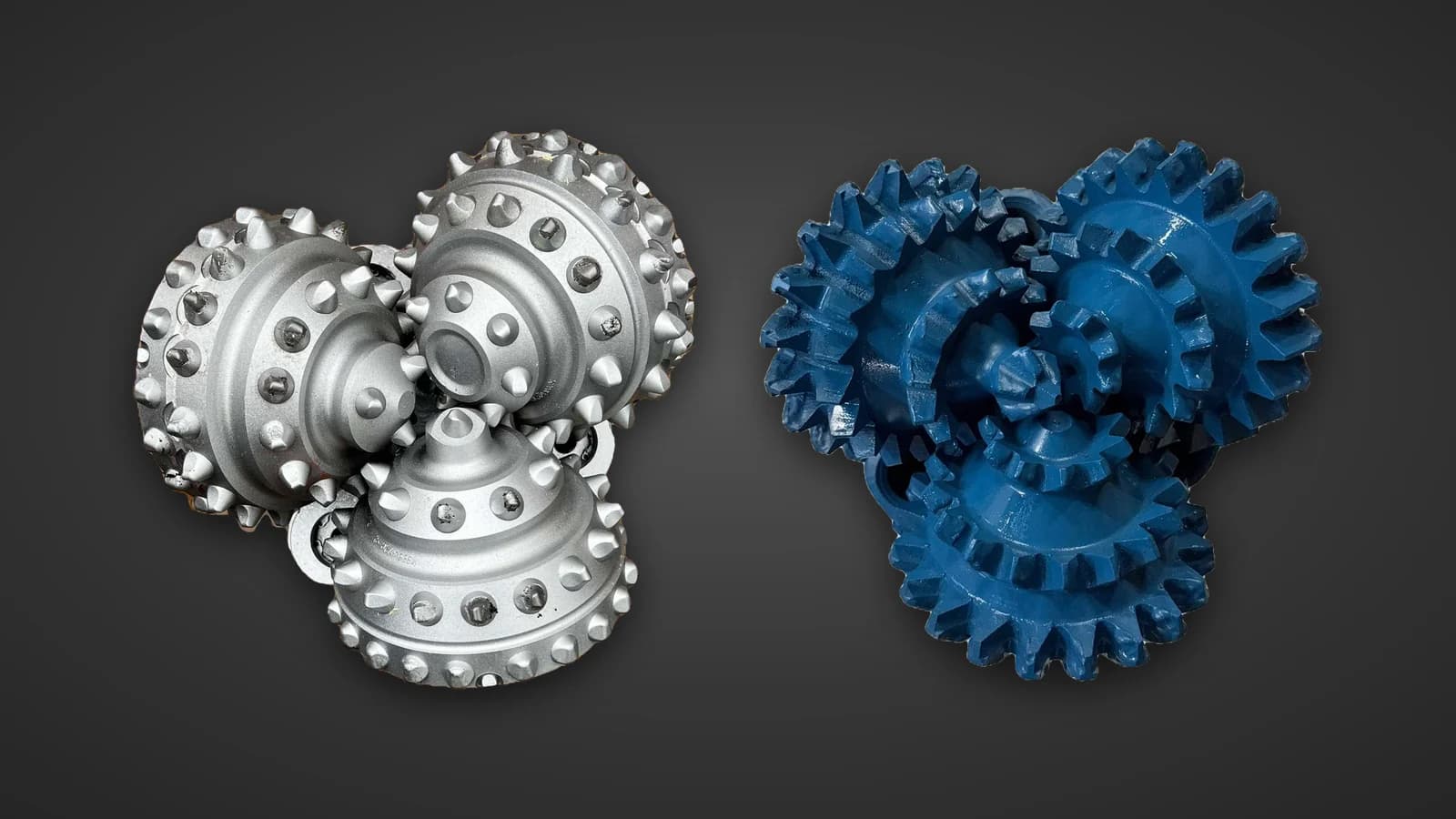
A tricone bit breaks rock by crushing and gouging: three rotating cones press teeth or carbide buttons into the formation until it fails. A PDC bit has no moving parts at all — its polycrystalline diamond cutters shear the rock continuously, like a lathe tool. That single difference explains almost everything about when to choose which.
Crushing needs weight. Shearing needs rotation. A tricone converts weight on bit into penetration; a PDC converts revolutions into penetration. If your rig can supply plenty of pulldown but not much RPM, the tricone will look better. If you have a good rotary head and can keep a steady torque, the PDC usually wins.
Where PDC bits win
Homogeneous soft and medium formations. Clay, marl, chalk, soft to medium sandstone and evaporites are where PDC bits are dramatically faster. Penetration rates of two to four times a comparable tricone are routine, because the cutters shear continuously instead of waiting for the next tooth to land.
Long runs. There are no bearings and no cones to lose. A PDC bit can stay in the hole for hundreds of metres in the right formation, and every avoided round trip is an hour or more saved.
Small rigs with limited pulldown. Because the mechanism is shearing, PDC bits work at lower weight on bit than a tricone needs to be productive — an advantage on light truck-mounted water-well rigs.
Air or mud, both fine. With adequate flow to keep the cutter face clean, PDC bits work in both circulation systems.
Where tricone bits win
Hard, broken and interbedded ground. The instant a PDC cutter meets chert nodules, flint bands, boulders or hard stringers in a soft matrix, it chips. A chipped diamond table does not recover — it accelerates its own destruction. Tricones tolerate that abuse far better.
Anything with a real risk of junk in the hole. Old casing, tools, gravel pack from an adjacent hole: a tricone will survive contacts that destroy a PDC in seconds.
Very hard, non-abrasive rock. In granite and basalt, TCI tricones or DTH hammers remain the practical answer for most water-well contractors, because the PDC bits that can handle those formations cost far more than the job supports.
Unpredictable geology. If you genuinely do not know what is below, a tricone is the lower-variance choice. It will rarely be the fastest, and it will almost never be a total loss.
The economics, honestly
What a PDC bit costs depends on how it is built. The cast three- and four-blade bits used in water wells usually cost less than a tricone of the same diameter; matrix-body bits cost about as much as a TCI tricone, sometimes more. Either way, the invoice is the wrong comparison — the cost per metre is the right one. In a consistent soft-to-medium profile, a PDC bit that drills 400 m where a tricone drilled 120 m is cheaper per metre even before you count the saved trips.
The same arithmetic runs the other way in mixed ground. One boulder horizon can retire a PDC bit at ten metres. That is the risk you are pricing when you choose.
A decision checklist
- Is the profile consistent? Consistent and soft-to-medium → PDC. Mixed, bouldery or interbedded → tricone.
- How hard is the hardest bench? If anything above medium-hard appears → tricone (TCI, sealed bearing).
- How deep, and how expensive is a trip? Deep and expensive → the longer PDC run pays.
- What can the rig deliver? High RPM and steady torque → PDC. High pulldown, low RPM → tricone.
- What is the junk risk? Any real risk → tricone.
Blade count, briefly
PDC bits are specified by blade count. Fewer blades means deeper cutter engagement and a faster penetration rate in soft rock; more blades means more cutters sharing the load, better stability and longer life in harder or more abrasive rock.
- 3 blades — soft formations, maximum penetration rate.
- 4 blades — the general-purpose choice for water wells; most of our stock.
- 5 blades and more — medium-hard and abrasive formations, longer life.
Two ways a PDC bit is built
Blade count is not the whole story. The three- and four-blade bits are a one-piece cast steel body: the blades are part of the casting, the face is open, and cuttings clear easily. That is what makes them quick and forgiving in water-well work.
The four-, five- and six-blade bits are built differently — a matrix body (tungsten carbide) or a reinforced steel body, with nozzles set into the face and the cutters packed more closely. It is a more expensive construction, and it is what deeper and harder drilling, oil wells included, asks for.
Neither kind has blades welded on. In both, blade and body are one piece; what changes is the material and how densely the face is cut.
The pragmatic answer
Most contractors we supply run both. A PDC in the soft overburden section, a tricone once the profile turns hard or unpredictable. Choosing per section rather than per well is what actually lowers the cost per metre — and it is why we keep both families on the shelf in the same diameters.